


“The plans of the diligent lead to profit as surely as haste leads to poverty.” — Proverbs 21:5 (NIV)
A Lesson in Planning Ahead
In a small coastal town, a group of fishermen worked tirelessly each day to bring in their catch. One fisherman, however, stood out. He always set aside a portion of his catch, selling enough to meet his needs but also saving for the off-season when storms would make fishing impossible. When the harsh winter came, while others struggled, he had enough to share. His preparation didn’t just protect him—it blessed others.
That’s the heart of biblical stewardship. It’s not about hoarding or fearing lack. It’s about managing God’s provision with wisdom so we can live in peace, bless others, and bring glory to Him.
Welcome to the Final Week of the Series
Welcome to Week 4 of our series, Faith & Finances: Walking with God in a Wealth-Driven World. In Week 1, “Why God Cares About Your Wallet and Your Walk,” we learned that God’s concern for our finances is rooted in His desire for our whole life to glorify Him. In Week 2, “Blessed or Broke? Rethinking the Christian Mindset Around Money,” we challenged poverty thinking and explored biblical abundance. In Week 3, “Rich in Purpose: How Wealth Can Strengthen Your Christian Walk,” we saw how wealth, used with intention, can serve God’s Kingdom.
Now, in our final installment, we turn to practical wisdom—how to manage God’s provision so that we live free from unnecessary struggle and positioned for generosity.
Why Stewardship Matters
Jesus taught in Luke 14:28-30 that before building a tower, a wise builder sits down and counts the cost. Budgeting is our modern-day way of “counting the cost.” It’s not just a financial tool—it’s a spiritual discipline that reflects trust, order, and responsibility.
Joseph, in Genesis, is one of the Bible’s clearest examples of wise stewardship. He managed Egypt’s resources so well during years of abundance that, when famine struck, there was more than enough to feed nations. The Proverbs 31 woman also modeled diligence, planning, and foresight in providing for her household.
Practical Steps to Stewardship
Start with a simple monthly budget. Include categories that reflect your needs, values, and Kingdom priorities. Proverbs 21:5 reminds us that diligent planning leads to plenty, while haste leads to want.
Set one financial goal—whether paying off debt, saving for a mission trip, or increasing your giving—and work toward it steadily. Invite God into your decision-making, praying over both major purchases and everyday spending.
Freedom Through Financial Discipline
Discipline in finances is not about restriction—it’s about freedom. It frees you from living paycheck to paycheck, from the anxiety of not knowing where your money is going, and from the inability to respond when God prompts you to give.
When we manage well what God entrusts to us, we position ourselves to bless others without hesitation. Matthew 6:33 reminds us to seek God’s Kingdom first, and all these things will be given to us as well.
A Final Challenge and Invitation
This week, take the time to create your budget, set your financial goal, and ask God to show you one area where you can grow in faith-filled stewardship.
If you’ve missed any part of this series, I encourage you to read the previous articles—they lay a strong foundation for what we’ve learned today. And if you haven’t already, subscribe to the EXCEL2FAITH Newsletter at www.excel2faith.com. It’s completely free and my way of expressing gratitude to God and paying it forward.

📝 Quick Challenge: Fill-in-the-Blank Verse
Complete this verse from Luke 14:28 (NIV):
“Suppose one of you wants to build a __________.
Won’t you first sit down and estimate the __________
to see if you have enough __________ to complete it?”
✔ Say it aloud twice after filling in the blanks.
💭 Ask yourself: Do I plan my finances with the same care and foresight?
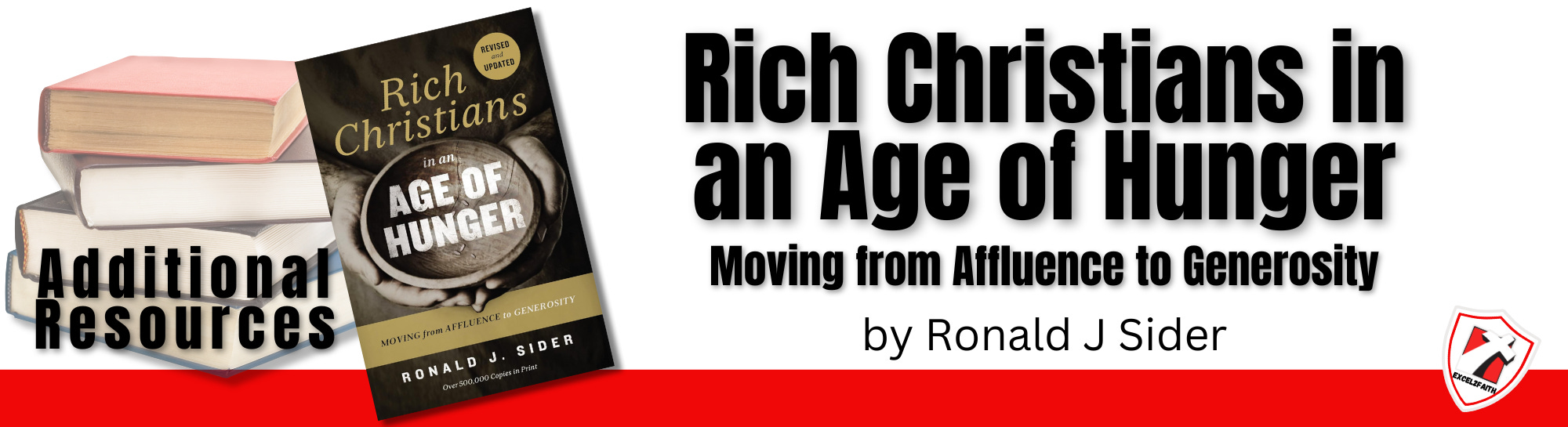
Rich Christians in an Age of Hunger: Moving from Affluence to Generosity
Ronald J. Sider’s Rich Christians in an Age of Hunger is a bold and deeply compassionate call for believers to rethink the way we view and use wealth. Sider presents a sobering reality—the global disparity between rich and poor—and challenges Christians to align their finances with God’s heart for justice, compassion, and generosity. He doesn’t simply highlight the problem; he offers a biblical blueprint for living out our faith in a world of need, moving from self-focused affluence to Kingdom-centered giving.
In our Week 4 blog, “Stewardship Over Struggle: Learning to Manage God’s Provision Wisely,” we discussed how budgeting and financial discipline are about more than numbers—they are about freedom and faithfulness. Sider’s message perfectly complements that truth, reminding us that good stewardship is not just about managing money well, but about releasing it into God’s purposes to bless others and advance His Kingdom.
This is more than a book; it’s an invitation to live generously, love deeply, and invest eternally.

Lord, thank You for every good gift You have placed in my care. Teach me to handle Your provision with wisdom, diligence, and faith, so that I may honor You in every decision I make. Help me to plan well, give freely, and trust You completely. May my life reflect a heart fully surrendered to Your will and rich in service to Your Kingdom.