
“Above all else, guard your heart, for everything you do flows from it.” Proverbs 4:23 (NIV)
The request arrives just as you sit down with your family. Someone needs another favor, and you know what saying yes will cost. Still, saying no feels uncomfortable, especially when you want your life to reflect Jesus.
We began September by exploring love that seeks another person’s good. Last week, we considered forgiveness that releases offense without automatically restoring trust. Now comes a question many believers carry: If I am called to love sacrificially, when is setting a limit faithful?
Love Takes Its Shape From Jesus
Jesus shows us a love that is compassionate and faithful to the Father. Following Him means allowing His character to shape our decisions, even when someone would prefer a different answer.
Sometimes that means accepting an inconvenient request. Love interrupts our schedules and challenges our preferences. Discomfort alone does not mean we need a boundary.
At other times, agreeing repeatedly allows dishonesty to continue, neglects responsibilities God has entrusted to us, or promises more than we can faithfully give. A loving response must take those realities seriously.
Luke records Jesus’ response amid growing demands: “But Jesus often withdrew to lonely places and prayed.” (Luke 5:16, NIV) His example invites us to bring people’s needs before the Father without letting every expectation determine our response.
Guard Your Heart Without Closing It
Proverbs 4 places guarding the heart within a father’s instruction to pursue wisdom and turn away from evil. The concern goes beyond protecting our feelings to the inner life that shapes our speech, choices, and conduct.
That includes examining what is happening within us. We can establish a sensible limit while enjoying another person’s disappointment. We can also keep saying yes while resentment grows beneath our helpfulness.
Discernment asks us to examine the relationship’s pattern and our own motives. Am I protecting a responsibility, or avoiding an uncomfortable act of love? Am I allowing someone’s displeasure to govern my decisions? Do I want this person’s good, even if they misunderstand me?
A boundary can express what we can offer or what behavior we will participate in. It leaves room for compassion while clarifying our responsibilities.
Help That Makes Room for Responsibility
Paul writes, “Bear one another’s burdens, and so fulfill the law of Christ.” (Galatians 6:2, NKJV) He also reminds believers, “For each one shall bear his own load.” (Galatians 6:5, NKJV)
The surrounding passage emphasizes gentle restoration and humble self-examination. Mutual care and personal accountability belong in the same Christian community.
We need that balance when helping becomes an effort to prevent someone from facing every consequence. Paying another bill, covering another commitment, or making another excuse may bring relief while leaving the underlying pattern untouched.
Circumstances matter. Illness, grief, disability, or crisis may call for sustained, costly help. Discernment requires patient attention to what a person can actually carry.
With a friend who repeatedly abandons commitments, you might offer help planning the next step while declining to take over again. With church responsibilities, you might explain that an additional role would prevent you from honoring existing commitments.
As we explored last week, forgiveness can remain sincere while access changes. Releasing vengeance does not require returning to an arrangement that continues to cause harm. Wise counsel can help us recognize what needs to change.
Let Your Next Step Hold Grace and Truth
“Rather, speaking the truth in love, we are to grow up in every way into him who is the head, into Christ.” (Ephesians 4:15, ESV)
Paul connects loving truthfulness with the church’s maturity. That gives our difficult conversations a purpose: becoming more like Jesus together.
A clear response might sound like this: “I care about you, and I can help for an hour on Saturday. I cannot take responsibility for the whole project.”
Speak respectfully, keep your commitment, and allow the other person to have feelings you cannot resolve for them. Their disappointment deserves compassion, but it does not automatically mean your decision was wrong.
Scripture also addresses our tone: “A gentle answer turns away wrath, But a harsh word stirs up anger.” (Proverbs 15:1, NASB) Gentleness helps us communicate clearly without turning a necessary limit into an attack.
This week, bring one recurring request before God. Prayerfully decide what you can faithfully offer, then communicate that limit with kindness. Use the free download, The E2F Christ-Centered Relationship Framework, and its Relationship Check-In to guide your reflection.
You can keep seeking someone’s good while acknowledging that unlimited availability is beyond what you can give. Let your yes and your no grow from a heart learning to follow Jesus.
Lord Jesus, give me wisdom to love with courage and humility. Keep my heart tender as You teach me to honor You in what I offer and what I must decline.
Subscribe to the EXCEL2FAITH Newsletter as we continue learning to build relationships that reflect Christ.


A Loving Limit or Something Else?
Take two minutes to test your discernment. Label each response B for a healthy boundary, P for people-pleasing, or R for retaliation. Look closely at the motive behind the words.
___ “I’ll agree because I’m afraid you’ll be upset, even though I cannot honor this commitment.”
___ “I care about resolving this. If the yelling continues, I’ll pause our conversation until we can speak respectfully.”
___ “You ignored me when I needed help. Now you can see how it feels.”
___ “I can help you make a plan, but I cannot keep taking over responsibilities you are able to manage.”
___ “I’ll say yes to keep everyone happy, even though it means breaking a promise I’ve already made.”
___ “I’m withholding my help because I want you to suffer for disappointing me.”
Check your answers: 1. P | 2. B | 3. R | 4. B | 5. P | 6. R
Make It Personal
Choose one recurring request and complete this sentence:
“Because I care about __________, I can offer __________, but I cannot commit to __________.”
Before sharing your response, ask God: Am I seeking this person’s good while honoring my responsibilities, or am I trying to avoid displeasure or get even?
A healthy boundary begins with discernment and becomes visible through a truthful, loving response.
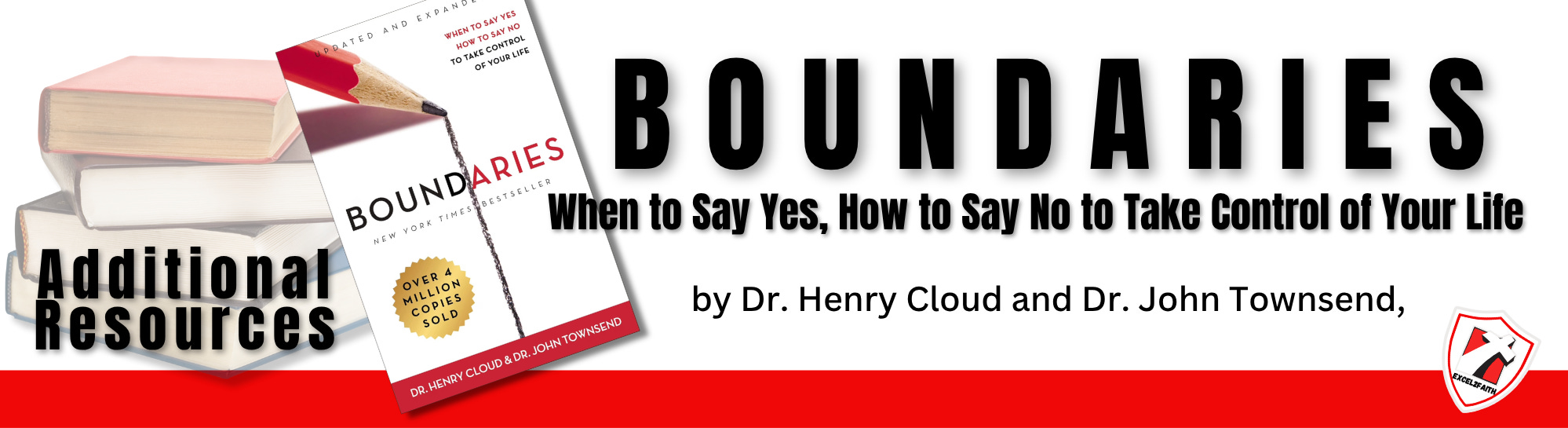
Boundaries: When to Say Yes, How to Say No to Take Control of Your Life
Saying yes can feel loving until every commitment leaves you exhausted, resentful, and wondering where your own responsibilities went.
In Boundaries, Dr. Henry Cloud and Dr. John Townsend explore why healthy limits matter and how Christians can establish them without abandoning compassion. Their central distinction is practical: we are responsible for our choices, attitudes, and actions, but we cannot assume responsibility for everyone else’s decisions.
Through biblical teaching and relatable examples, the authors examine boundaries in family relationships, friendships, marriage, and work. They address familiar obstacles, including guilt, fear of rejection, and the pressure to keep others happy. Readers are encouraged to communicate honestly, recognize harmful patterns, and develop the self-discipline needed to honor their own limits.
This makes the book a natural companion to “Healthy Boundaries: How to Love Like Jesus Without Saying Yes to Everything.” Both invite us to consider whether our help strengthens others or repeatedly takes over what they need to carry themselves.
For anyone struggling to give an honest answer, this book offers practical language and thoughtful encouragement. Loving wisely takes practice, and you can begin today.
Purchase Boundaries and subscribe to The EXCEL2FAITH Newsletter for encouragement in building relationships that reflect Christ.


Heavenly Father, You know how deeply I want to love others well and how often I struggle with guilt, fear, or resentment when I need to set a limit. Draw me closer to You in prayer, teaching me to seek Your wisdom before I answer and to trust Your guidance when obedience feels uncomfortable. Give me the courage to speak truth gently, the humility to examine my motives, and a tender heart that seeks another person’s good while honoring the responsibilities You have entrusted to me. Lord Jesus, deepen my relationship with You until both my yes and my no flow from Your love, and help me return to Your presence each day for the grace to walk faithfully with You.
Amen.