You can acknowledge the hurt without allowing it to keep holding your heart.
YOUR FAITH FOCUS
Before you read, consider this…
Some hurts are difficult to release because letting go can feel as though we are saying what happened was acceptable. But what if holding on to the offense is costing you more than it is costing the person who hurt you? Where does forgiveness end and wisdom begin?

“Be kind and compassionate to one another, forgiving each other, just as in Christ God forgave you.” Ephesians 4:32 (NIV)
Some wounds disappear quickly. Others remain attached to a name, a conversation, a betrayal, or a moment we wish had never happened. We may sincerely love God and still discover that remembering what someone did can awaken anger all over again.
That is where forgiveness becomes more than a Christian ideal. It becomes a decision about what will continue to occupy our hearts.
Sometimes the hardest offenses come from people we expected to love us well: a spouse, parent, sibling, friend, coworker, or fellow believer. The closer the relationship, the deeper the disappointment can reach. Scripture never asks us to deny that reality. Instead, God invites us to deal with the wound without letting it determine who we become.
Forgiveness Begins With What God Has Given Us
Paul’s instruction in Ephesians 4:32 was written to believers learning how their new life in Christ should reshape their relationships. Notice the standard: “just as in Christ God forgave you.” Christian forgiveness does not begin with whether another person deserves mercy. It begins with remembering the mercy we have received.
Jesus made this unmistakable in the parable of the unforgiving servant. After being released from an enormous debt, the servant refused mercy to someone who owed him far less (Matthew 18:23–35, NIV). Jesus exposed the contradiction of receiving grace while refusing to extend it.
That does not make another person’s wrongdoing insignificant. Forgiveness does not require calling evil good, pretending the wound did not matter, or denying consequences. It means refusing to make another person’s debt the permanent possession of your heart.
Paul writes, “Forgive as the Lord forgave you” (Colossians 3:13, NIV). We forgive from grace received, not because the pain was imaginary.
Releasing the Right to Get Even
One reason offense holds us so tightly is that we want the scales balanced. We replay conversations, rehearse what should have been said, or imagine the day the other person finally understands what they caused.
Scripture gives us another way. Romans 12:19 says, “Do not take revenge… ‘It is mine to avenge; I will repay,’ says the Lord” (NIV). Forgiveness releases personal vengeance into God’s hands. We surrender our demand to settle the account ourselves.
This can be difficult because releasing revenge may feel like surrendering justice. It is not. It is acknowledging that God is a better judge than we are.
You may still need to address wrongdoing, establish consequences, seek wise counsel, or create distance. But you can do those things without allowing bitterness to become your companion. Forgiveness says, “God, I will not spend my life collecting this debt. I place it in Your hands.”
Forgiveness Is Not the Same as Trust
This distinction matters enormously. One person can offer forgiveness. Reconciliation requires participation from both. Trust, once damaged, normally requires truthfulness, repentance, changed behavior, and time.
Jesus Himself connected relational repair with honest confrontation. “If your brother or sister sins against you, rebuke them; and if they repent, forgive them” (Luke 17:3, NIV). Biblical love does not require pretending nothing happened. Grace and truth belong together.
You can forgive someone and still recognize that restoring the relationship would be unwise today. You can release resentment while maintaining a necessary boundary. You can pray for someone without immediately giving that person the same access they once had.
That is not failed forgiveness. Sometimes it is wisdom.
Freedom Happens Inside You First
Unforgiveness promises protection, but over time it can keep us emotionally connected to the very injury we want to escape. The person may have moved on while we continue carrying the conversation.
Hebrews 12:15 warns believers to see that “no bitter root grows up to cause trouble” (NIV). Bitterness rarely stays neatly contained. It can influence how we interpret other people, how quickly we become defensive, and how freely we love.
Forgiveness interrupts that cycle. It does not rewrite yesterday. It changes what yesterday is allowed to control today.
Perhaps there is a name you have avoided bringing honestly before God. Your practical step this week is simple: name the offense in prayer, tell God truthfully what it cost you, and consciously release your right to revenge. You may need to repeat that surrender when the memory returns. Forgiveness can be a decisive choice followed by many faithful reminders of that choice.
Freedom does not mean forgetting. It means the offense no longer gets to rule your heart.
Put forgiveness into practice. Download the free EXCEL2FAITH Christ-Centered Relationship Framework to reflect on an important relationship and take one intentional step toward loving, forgiving, discerning, and encouraging more like Christ.
Lord Jesus, thank You for the mercy You have given me. Help me release what I cannot change, forgive as I have been forgiven, and walk forward with both grace and wisdom. Amen.
Continue growing in relationships that reflect Christ. Subscribe to the EXCEL2FAITH Newsletter


Forgiveness or Something Else?
Think you’ve got forgiveness figured out? For each statement below, decide whether it describes FORGIVENESS, RECONCILIATION, or TRUST. Write F, R, or T beside each one.
___ I release my personal desire to make the person pay.
___ Both people participate in repairing the relationship.
___ This may need to be rebuilt gradually through consistent, changed behavior.
___ I place the offense and my demand for vengeance into God’s hands.
___ This does not require giving someone immediate access to my life again.
___ Repentance, honesty, and willingness from both people help make this possible.
BONUS: Complete the verse from memory
“Be kind and compassionate to one another, __________ each other, just as in Christ God __________ you.”
Ephesians 4:32 (NIV)
Answers:
F | 2. R | 3. T | 4. F | 5. F | 6. R
Bonus: forgiving / forgave
One Last Question
Is there an offense you are asking God to help you release today?
You don’t need to write the person’s name. Simply write:
“Lord, I release __________________________ into Your hands.”
Forgiving What You Can’t Forget
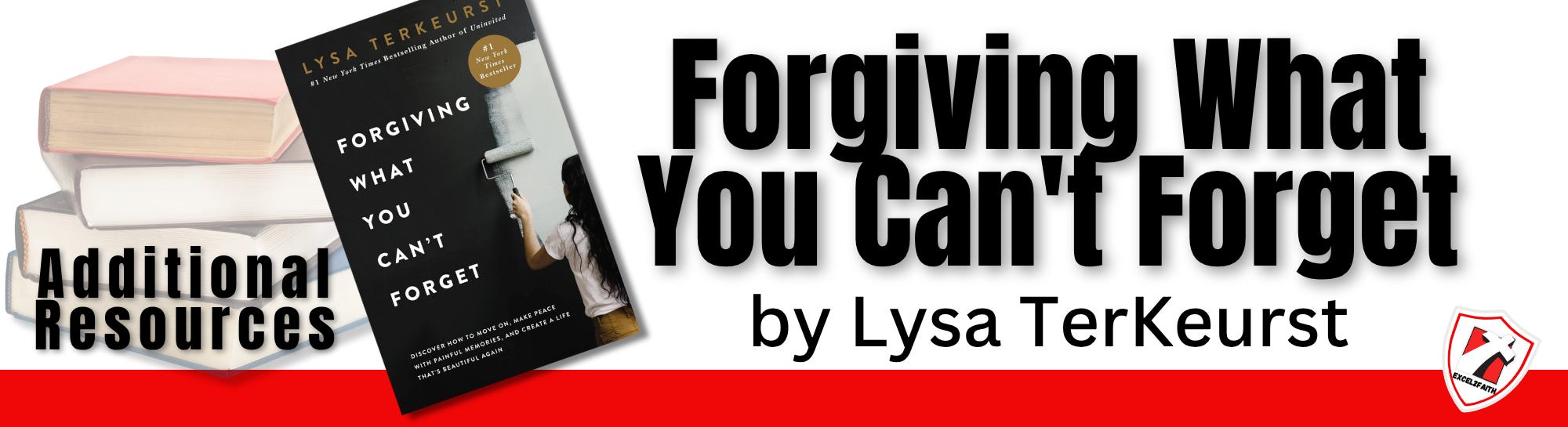
Some wounds heal quickly. Others leave memories that resurface when we least expect them. In Forgiving What You Can’t Forget, Lysa TerKeurst speaks directly to anyone who knows forgiveness is biblical but has discovered that actually forgiving someone can be painfully difficult.
TerKeurst approaches forgiveness from the perspective of someone who has experienced deep relational hurt herself. With vulnerability, biblical insight, and practical encouragement, she explores how unresolved pain can keep us connected to the very experiences we desperately want to move beyond. Rather than suggesting that forgiveness means minimizing what happened, she encourages readers to acknowledge their pain honestly while allowing God to begin healing what remains wounded.
That message beautifully complements our article, “Forgiveness and Freedom: How Letting Go of Offense Sets Your Heart Free.” Forgiveness does not erase the past, automatically restore trust, or require us to pretend everything is fine. It releases our demand to personally settle the debt and places what happened into God’s hands.
If you are carrying an offense you cannot seem to forget, this book offers compassionate encouragement for moving toward freedom without denying your story.
Purchase Forgiving What You Can’t Forget and continue your journey toward healing, then subscribe to The EXCEL2FAITH Newsletter for more practical, Christ-centered encouragement.


Heavenly Father, You know every wound I carry, every disappointment I struggle to release, and every place where hurt has quietly taken root in my heart. Through the grace You have shown me in Christ, give me the strength to forgive, surrender my desire for vengeance, and trust You with the justice, healing, and restoration I cannot accomplish on my own. Draw me closer to You in prayer, especially when painful memories return, and teach me to seek Your presence until Your grace becomes greater in my heart than the offense I have carried. Lord, deepen my relationship with You so completely that I can walk forward in freedom, love others with wisdom, and increasingly reflect the forgiving heart of Jesus.
Amen.