
“I can do all things through Christ who strengthens me.” Philippians 4:13 (NKJV)
A difficult week can make us reach for a familiar verse. Maybe the interview went badly, the medical news is uncertain, or a relationship remains strained. We read, “I can do all things through Christ who strengthens me,” and hope it means the outcome we want is guaranteed. But what if the verse offers something deeper than a guarantee?
Many of us learned to trust the Bible long before we learned to study it. That trust is precious. Yet accepting Scripture as God’s Word should make us curious about what God actually said. Reading the verses around a favorite promise is one way to listen more closely. A pastor can introduce us to a beautiful truth, but we need not stop there. Like tasting a small piece of cake, we may be grateful for what we received and still hunger for more.
The Conversation Around the Verse
Paul wrote Philippians while imprisoned, thanking believers who had renewed their support for him. He appreciated their gift, but he wanted them to know that his peace did not depend on receiving it. In Philippians 4:11–12 (NKJV), he says he had learned contentment through both need and abundance, hunger and fullness. Only then does he say he can do all things through Christ who strengthens him.
Those “all things” belong to that conversation. Paul is describing Christ’s strength to endure changing circumstances faithfully, not claiming that every ambition will succeed. The sentence remains powerful when we read it in place. If an opportunity closes or a hardship lasts longer than we hoped, Christ has not failed us. His strength can sustain us there, too.
That may feel less exciting than “name it and claim it.” It is also more dependable. God’s promises are not made stronger by stretching them to cover our every preference. We can ask boldly for a desired outcome while trusting that Christ will remain with us if the answer differs from what we imagined.
Widen the Frame, Deepen the Meaning
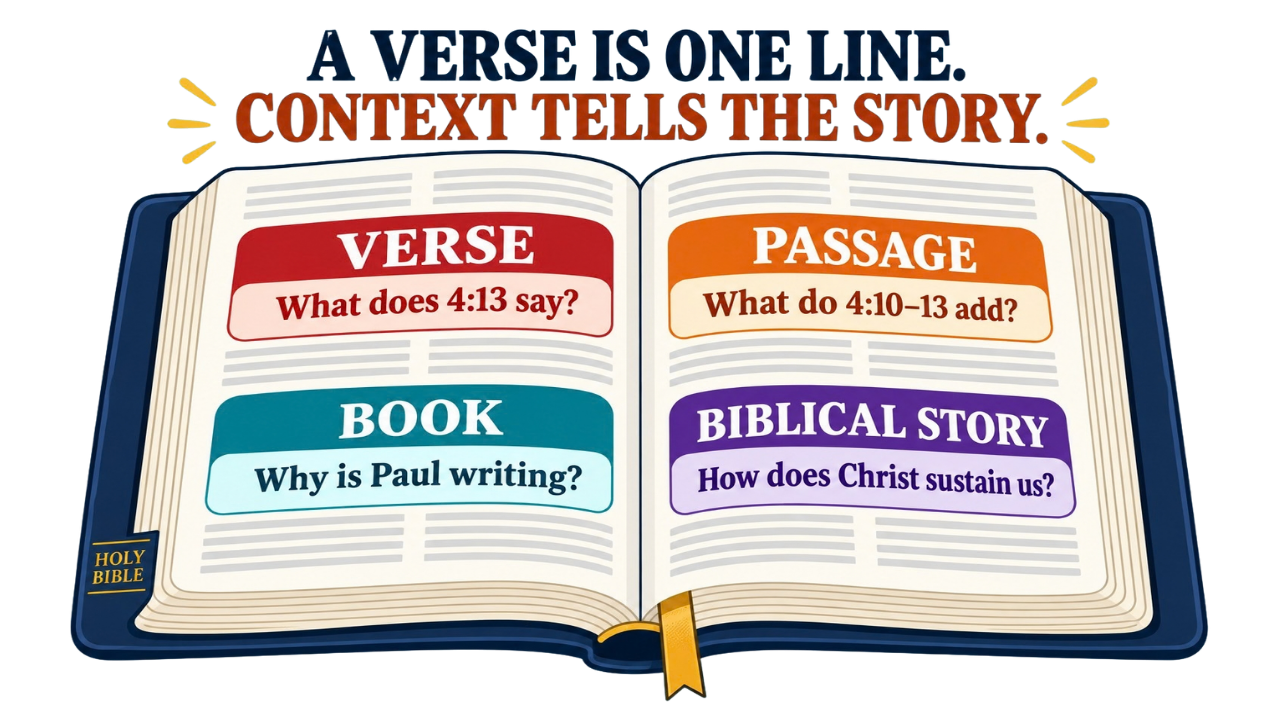
Picture a familiar verse widening in four steps. Begin with the verse itself: what does it say? Read the surrounding passage: what changes when you hear the whole conversation? Consider the book: who wrote it, to whom, and why? Then ask how it fits the larger biblical story and God’s work through Christ.
Each step adds clarity. None makes the verse less important. Starting with Philippians 4:13, read verses 10–13 to hear Paul’s gratitude and his learned contentment. Then notice the letter’s larger encouragement: believers can stand together and remain faithful amid suffering (Philippians 1:27–30, NIV). The book does not pretend hardship disappears when we follow Jesus.
Finally, place the passage within the larger biblical story. Jesus told His followers that they would face trouble, yet could take heart because He had overcome the world (John 16:33, NIV). Paul’s testimony fits that pattern: strength in Christ is real even when circumstances remain hard. The wider view makes his words more personal, not less. We are invited to depend on a living Savior rather than on our ability to secure a particular result.
Three Questions Before You Apply It
When a verse speaks to you, pause before turning it into a promise about your situation. Ask: Who is speaking, and to whom? What circumstances prompted these words? What do the nearby sentences tell me the writer means? For Philippians 4:13, those questions lead us back to Paul’s imprisonment, the church’s support, and his testimony about contentment.
Then ask how that truth meets your life. Suppose you are waiting to hear whether you got a job. This passage does not assure you that the offer is yours. It gives you reason to pray honestly, prepare wisely, and trust Christ for strength whether the answer is yes or no. That is no small gift when uncertainty keeps you awake at night.
We can still receive encouragement from a verse quoted in a sermon, shared by a friend, or printed on a card. But a small taste can awaken a healthy hunger. Open the passage for yourself. Let the words before and after it challenge your assumptions and reveal what you might have missed. God’s Word deserves that attention, and so does the life you are trying to live by it.
This week, read Philippians 4:10–13 slowly. Write down one hope you have been attaching to verse 13, then ask what Paul actually teaches about Christ’s strength in both plenty and need. Bring that hope to God without demanding that He fulfill it your way.
Lord Jesus, teach me to hear Your Word faithfully and trust Your strength in whatever this week brings. Help me seek Your truth more deeply than the answer I hoped to find.
Subscribe to the EXCEL2FAITH Newsletter as we continue learning to understand, remember, and live God’s Word together.

How to Read the Bible for All Its Worth
Have you ever finished reading a Bible verse and wondered whether you understood it? Gordon D. Fee and Douglas Stuart wrote How to Read the Bible for All Its Worth for readers who want to go beyond familiar words.
Their guide explains why a letter, a psalm, a Gospel, and a prophetic book cannot all be read in precisely the same way. With practical examples, the authors help you consider a passage’s audience, literary form, and context before asking what it means today. You do not need a theology degree to benefit from their approach. You need curiosity, patience, and a willingness to let the Bible speak on its own terms.
That is exactly the invitation in “Before You Claim That Bible Verse, Read This.” Philippians 4:13 becomes richer when we hear Paul speak about contentment in both plenty and need. Fee and Stuart offer tools for making that kind of discovery throughout Scripture with fresh eyes again, turning a quick glance at a favorite verse into a deeper conversation with God’s Word.
Purchase How to Read the Bible for All Its Worth, and subscribe to The EXCEL2FAITH Newsletter for more encouragement to read, understand, and live Scripture.


Heavenly Father, awaken a deeper hunger in me for Your Word, and help me listen for what You are saying rather than only what I hope to hear. When disappointment leaves me weary or uncertain, draw me close and remind me that Christ’s strength can sustain me even when Your answer differs from my desires. Teach me to come to You often in prayer, bringing my questions, hopes, and struggles with an honest heart ready to trust and obey. Let every moment spent in Scripture and conversation with You deepen my love for You and shape the way I live, in Jesus’ name,
amen.